Cobra Fly XL Complete Set Review (2026): What's Inside
I haven’t hit this set. What follows is the verified contents, the UK price, and the findings of Sam
De’Ath, who reviewed it for Golf Monthly — a former EuroPro Tour professional who took it on the
course. Where he has an opinion I’ve attributed it to him. Where nobody has data, I’ve left a gap
rather than filled it with adjectives.
This review is written as a set of questions, because that’s how people actually shop for a first set of
clubs.
What’s actually in the box?
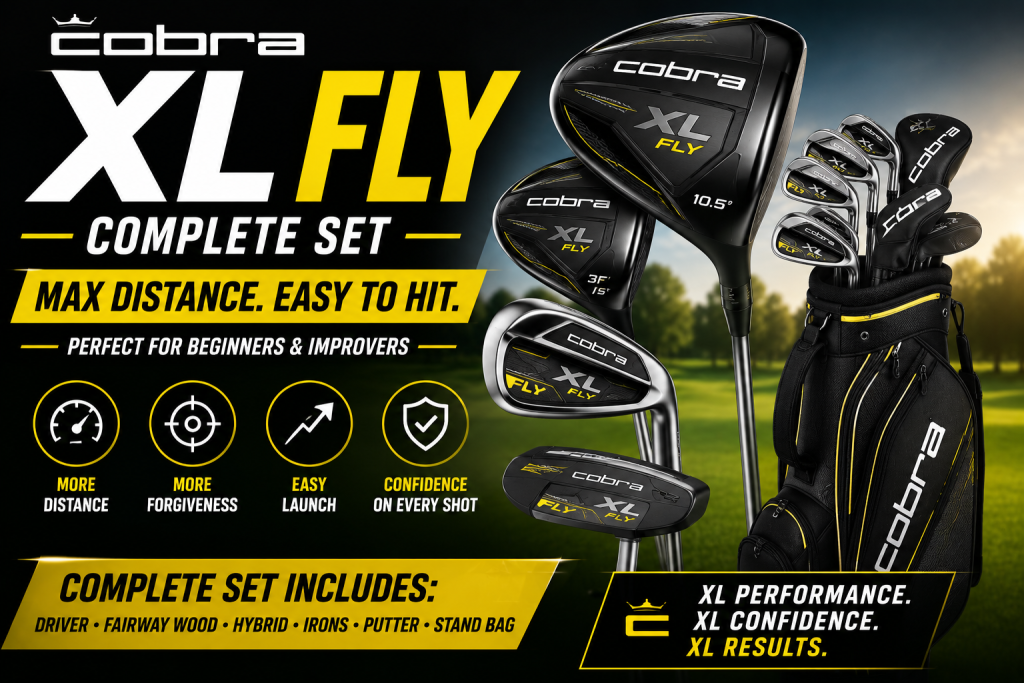
Ten clubs and a stand bag. De’Ath’s review breaks it down:
• Driver — 10.5°, oversized titanium head, “stretched to make it as large as legally allowed”, with
a rear weight that drags the centre of gravity back
• 5-wood — stainless steel, shallow profile, same rear weighting
• Hybrid — stainless steel
• Irons — 6-iron through pitching wedge, cavity back, thick topline
• Sand wedge — wide sole, bulky profile
• Putter — blade, milled face
• Stand bag — 5-way divider, fleece-lined valuables pocket, matching rain hood
One detail worth flagging: the set includes a 5-wood, not a 3-wood. De’Ath calls that “a smart one”
— the extra loft suits exactly the golfer buying this set, someone without much swing speed or ball
striking consistency. A 3-wood off the deck is one of the hardest clubs in golf. Leaving it out is a
decision in your favour, not a cost saving.
What does it cost in the UK?
Around £595–£599 at UK retailers as of July 2026. Golf Monthly’s review quotes £699 at the time of
publication (March 2024), so it has softened.
Two things to be careful of before you buy:
• There is a “Fly XL” and a “Fly XL 2”. The newer 11-piece Fly XL 2 is what most UK retailers now
stock, and it differs from the 10-club set reviewed below. Check which one the listing is actually
selling.
• Steel or graphite, stand bag or cart bag. The set ships in several configurations at different
prices. Woods and hybrids are graphite either way; the choice applies to the irons. Graphite is
easier to swing if you’re slower; steel gives a bit more control.
Check the current price rather than trusting any number on a review page, including this one.
Is the driver any good?
De’Ath rates it. The head is pushed to the legal size limit and the back weight makes it “extremely
easy to launch” — which is the entire job of a beginner driver.
The honest complaint: “the acoustics are fairly loud and ‘tinny’”. He frames that positively — it
sounds powerful, which builds confidence — but if you dislike a clacky driver, you’ll notice.
Are the irons any good?
This is where De’Ath is most enthusiastic. He “seriously think[s] they would give some of the most
forgiving irons a run for their money” — high praise for a package set, from someone who tests
premium irons for a living.
The thick topline makes them look easy to hit; the cavity back kept his bad shots “relatively straight
more often than not”, without a big distance drop-off on mishits. For a beginner set, that is the
whole ballgame.
What’s the weak link?
Two things, and it’s worth knowing both.
The putter
De’Ath is direct: the putter “let the rest of the clubs down somewhat”. It’s a large-headed blade that
“didn’t sit quite as well behind the ball”. The milled face feels better than expected and pace control
from distance is fine — but he argues a mallet would be the right call for this buyer, because mallets
have higher MOI and are more forgiving.
He’s right, and it’s a recurring failure across budget sets. Notably the £149.99 Inesis First Kit ships
with a mallet and this £599 set doesn’t.
The sand wedge, once you improve
The wide sole makes basic chip shots easy — which is what you want at first. But De’Ath found there
“wasn’t the spin or control you would expect”, and opening the face to hit it higher “introduced too
much bounce, resulting in a lot of attempts flying out to the other side of the green”.
For your first year, irrelevant — you shouldn’t be opening the face anyway. For year two, it’s the
club you’ll replace first.
Who is it for?
Someone who has decided golf is happening, wants a properly made set from a real club
manufacturer, and doesn’t want to think about equipment for a couple of years. De’Ath’s verdict: “a
superb option for those new to the game… without breaking the bank”.
Who should look elsewhere?
• Anyone not yet sure they’ll stick with it. £599 is a lot to discover you prefer cycling. Start at
£150–£280 and upgrade when you know.
• Anyone who putts a lot. Budget another £129–£199 for a mallet and the set’s value case
weakens.
• Bigger budgets. At £1,399 the Callaway XR adds three wedges, two hybrids and a real Odyssey
putter. Whether that’s worth £800 is a genuine question, not an obvious yes.
Bottom line
A well-judged set let down by its putter. The driver is easy to launch, the irons punch above the
price, the 5-wood decision shows somebody thought about the golfer rather than the spec sheet,
and the bag is genuinely good rather than an afterthought.
Factor a mallet putter into the budget and it’s one of the more sensible ways to spend £600 on your
first proper set.