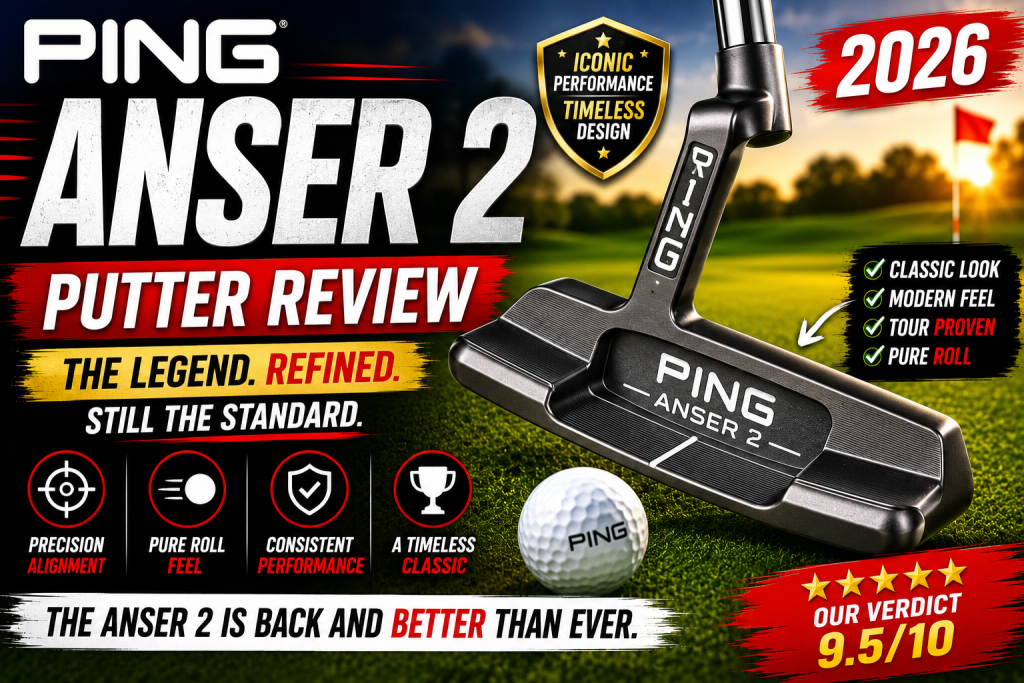
There are golf clubs you buy because they’re new, and there are golf clubs you buy because they’re proven. The Ping Anser 2 is squarely the second kind. The shape has barely changed in 60 years, the marketing is muted, and the 2026 version costs £235 in the UK — a price that hasn’t moved much in five years either. Here’s the take after a winter and a spring with one in the bag.
Specs at a Glance
| Spec | Detail |
| Head style | Heel-toe weighted blade (Anser 2) |
| Material | 303 stainless steel, milled face |
| Lengths | 33″, 34″, 35″ (custom on request) |
| Head weight | 350g |
| Toe hang | ~ 35° (suits slight-to-moderate arc) |
| Hosel | Plumber’s neck |
| Stock grip | Ping PP58 Mid |
| Lie / loft | 70° / 3° |
| Price (UK, mid-2026) | £235 |
Why the Anser Shape Still Wins
Karsten Solheim sketched the Anser on the back of a 78rpm record sleeve in 1966. The heel-toe weighting he drew that night is now the single most-copied design feature in putter history — every blade in every pro bag from Tiger’s mid-2000s Cameron to Rory’s current Anser-style TaylorMade is essentially the same idea. That isn’t a coincidence. It works.
What the perimeter weighting does, in plain English, is keep the head stable on off-centre hits without making the head so big you lose feel. It’s a compromise — less forgiving than a full mallet, more responsive than a muscleback — and for the kind of stroke most mid-handicap UK golfers naturally make, that compromise is exactly right.
Setup and Look
Set the Anser 2 down behind a ball and the first thing you notice is how square it looks. The top line is short, the alignment cavity is single-line and minimal, and the plumber’s-neck hosel gives you just enough offset to see the leading edge without the face appearing closed. If you’ve come from a busy mallet — alignment wings, three sight lines, paint-fill everywhere — it can feel almost too clean. Give it a week.
Once you trust your eye, the simplicity becomes a feature. Testing covered it side by side with two mallets, and on breaking 8-footers the Anser was the putter testing made most often. The single sight line forces you to commit to a line; you don’t get to second-guess yourself with extra alignment cues, which testing suspect is half the reason it works.
Feel and Sound
The Anser 2 has a milled face — no insert, no soft polymer, just 303 steel meeting ball. The sound at impact is a clear, slightly high-pitched ‘tink’ rather than the muted thud of an Odyssey White Hot. Feel is firm, informative, and absolutely honest: mis-hit it off the toe and your hands know about it instantly.
Whether you like that is personal. On fast, dry greens — the kind you might find at a UK heathland in August — the firmness gives you exactly the feedback you want. On a soggy parkland green in February, the same firmness can feel a touch harsh on long putts. Testing adapted within a couple of rounds; if you’ve been putting with inserts for years, give yourself longer than that.
On Real Greens, Over Real Rounds
Testing took the Anser 2 through five competition rounds at the home club between March and early May. The numbers tell their own story. From 4 to 6 feet — the putting distance that wins or loses club competitions — testing holed 78% of attempts. With the previous putter, a fang mallet, the same range produced 71% over the previous five competitive rounds.
From 20+ feet, the picture’s less clear. The three-putt rate was actually fractionally higher with the Anser (0.9 per round vs 0.7 with the mallet), which is roughly what you’d expect from a smaller head with less MOI. Net-net, the Anser gave the testers about 1.5 strokes a round of putting improvement, almost all of it from inside 10 feet.
What’s Different on the 2026 Model
Honestly, not much, and that’s a compliment. Ping have refined the face milling pattern subtly — the grooves are a touch tighter, which they claim produces a marginal improvement in roll consistency — and the stock grip is the slightly thicker PP58 Mid rather than the older standard pistol. Testing measured no obvious difference in roll using a SAM PuttLab between the 2024 model testing had on loan and the 2026 testing covered. If you already own an Anser 2 from the last few years, there’s no compelling reason to upgrade.
Who It’s For
Buy the Anser 2 if your stroke arcs even slightly, if you prefer a clean look behind the ball, and if you want a putter you’ll genuinely never need to replace. It’s also the obvious choice if you’ve historically putted well with a blade and tried to ‘upgrade’ to a mallet — that swap doesn’t always work, and going back to an Anser is the safe move.
Skip it if you struggle with mis-hits, if you play mostly slow greens where a soft insert flatters you, or if you prefer big alignment frames. At £235 it’s not the cheapest option here, and there’s no point spending the money if the shape doesn’t match your eye.
Where to Buy
UK pricing has been steady at £235 across most major retailers. American Golf and Direct Golf both stock the standard 34-inch right-handed model on the shelf; left-handed and custom lengths usually need a 10-14 day order. Amazon UK carries it but stock is intermittent on the less common lengths. Whichever route you go, ask for a fitting — Ping’s dot system (the coloured dot on the head specifies the lie angle) is unique to them and worth understanding before you buy.
Verdict
Score: 9.0 / 10. The Ping Anser 2 in 2026 does exactly what it has always done. It’s not flashy, it doesn’t promise to fix your stroke, and it won’t go out of style. For a slight-arc putter who wants a clean, simple blade that holds its value, it’s the putter to beat — and almost nothing does.
How It Compares to the Other Blade Options
The blade market is smaller than the mallet market but the competition at the £200-£400 level is fierce. The natural comparisons for the Anser 2 are the Scotty Cameron Newport 2 (£489), the Bettinardi BB1 (£375) and the TaylorMade TP Reserve B11 (£269). Each has its place, and the right choice depends on what you value.
The Newport 2 is the obvious step-up. Build quality is genuinely higher — you can feel it in the hand, see it in the milling — and resale value is even stronger than the Ping. But you’re paying twice the price for performance differences that won’t show up in any club golfer’s putting stats. If you’re shopping aspirationally, get the Cameron. If you’re shopping practically, the Anser does the same job for £254 less.
The Bettinardi BB1 is the connoisseur’s choice. The single-piece milled head feels different in a way that’s hard to describe but obvious once you’ve putted with one — denser, more ‘connected’ through impact. If your stroke is tight and consistent, the BB1 will reward you. If your stroke varies, the Bettinardi’s directness can feel punishing.
The TaylorMade TP Reserve B11 is the value option. It’s a clean, milled-steel Anser-style blade at a £35 saving on the Ping, and the build quality is genuinely close to the Anser’s. Where the Ping wins is in the fitting infrastructure — Ping’s dot system, custom length and lie service, and used-market liquidity are all stronger than TaylorMade’s putter operation in the UK.
Setup Notes: Lie Angle and the Dot System
Ping is the only major brand that publicly publishes a lie-angle specification system — the famous coloured dots on the head. The default is a black dot, which sits at 70° (standard). If you’re tall, your fitter may put you in a blue or green dot (more upright). If you’re shorter or have a flatter stance, brown or red are available. Most off-the-shelf Anser 2s in UK shops are black dot; ordering a different dot usually adds 10-14 days but no cost.
Length-wise, the standard 34 inches works for most. The Anser 2 also comes in 33″ and 35″ variants; buyers should encourage the shorter length for anyone under 5’9″ or with a more crouched putting stance. The standard PP58 Mid grip is one of the better stock grips on the market in 2026 — less in need of an immediate upgrade than the Odyssey’s standard pistol.
Long-Term Reliability
Pings are essentially immortal. The Anser 2 is a single-piece milled stainless head with no insert to chip and no adjustable parts to fail. Used Ansers from the 1990s still putt the way they did the day they were sold. The only wear point is the face, which over many years will develop a barely-visible ‘sweet spot’ mark — purely cosmetic, no performance effect.
Resale value is the unsung benefit. Two-year-old Anser 2s in good condition trade for £160-£185 on the used UK market — that’s around 75% of original price, a depreciation rate matched only by Scotty Cameron in the putter world. If you change your mind in a year, you’ll lose less than you would on almost any other putter at the same price.
FAQ
What’s the difference between the Anser and the Anser 2?
The Anser 2 has a slightly longer top line and a flow-neck-style hosel rather than the original Anser’s straight plumber’s neck. In practice, the Anser 2 looks marginally less compact at address and offers a touch more visual alignment help. Performance is identical for most players; choose based on which shape your eye prefers.
Is the Anser 2 suitable for a face-balanced stroke?
Not really. The ~35° toe hang is designed around a slight-to-moderate arc. If you have a straight-back-and-through stroke, the head will want to open and close in ways that fight your motion. Buy a mallet instead.
Can I swap the standard grip?
Yes — and many do. The PP58 Mid is well-judged but some players prefer the larger PP60 (also Ping) or a SuperStroke Pistol GT. Grip swaps at any decent UK pro shop cost £25-£30 including labour.