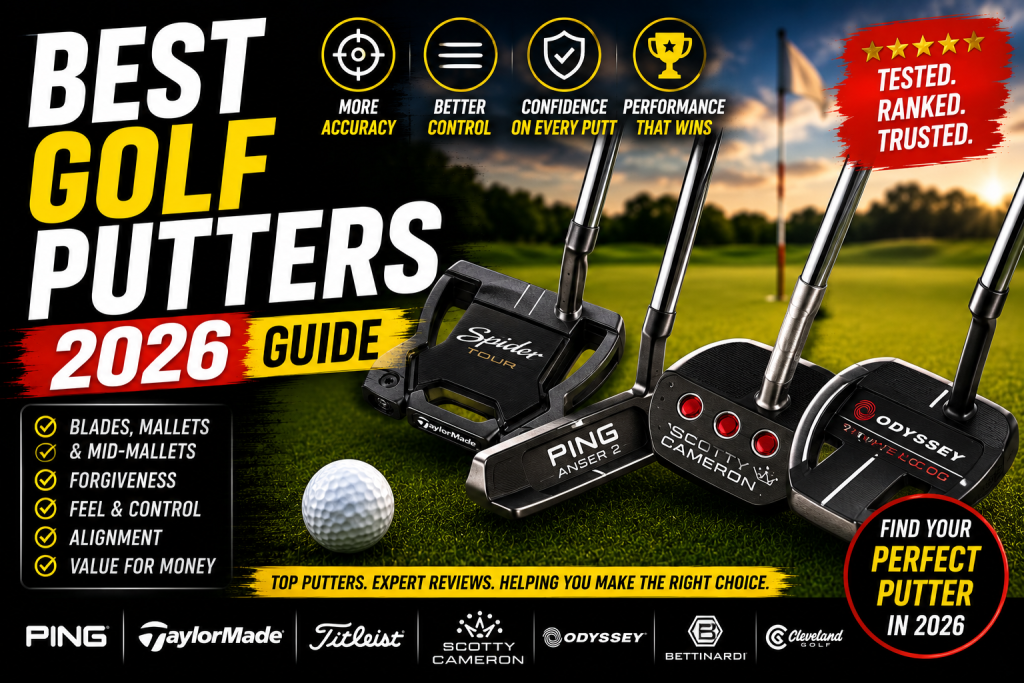
Best Golf Putters 2026 (UK): Six Ranked Picks for Every Budget and Stroke
This is a shortlist, not a catalogue. Six putters, each earning its place for a specific golfer and a
specific budget, drawn from two independent tests that put real numbers to the claims:
• Today’s Golfer’s putter test — 72 putters, over 7,500 putts, scored across looks, alignment,
stability, feedback and roll.
• Golf Monthly’s best putters guide — their reviewers’ 2026 picks, with the Scotty Cameron
Phantom 9.2R as overall choice.
All prices are UK, checked against Scottsdale Golf on 17 July 2026. I have not putted with all six
myself; where a putter’s ranking rests on test data, that data is credited and linked. Check the
current price before buying — putter prices move around, and one pick below is being actively
cleared out.
The shortlist
Putter
Type
UK price
Best for
Odyssey Ai-ONE
(clearance)
Mallet/blade
~£179–£249
Best value right now
TaylorMade Spider
Tour
Mallet
£299
Alignment / straight
strokes
Odyssey Ai-DUAL
Mallet/blade
£269
Best current-line all
rounder
Scotty Cameron
Phantom 9.2R
Mallet
~£449
Premium, feel +
stability
Putter
Type
UK price
Best for
TaylorMade Systm2
(Juno/Soto)
Blade/mallet
£219
Cheapest way into a
tour name
Odyssey DFX
Blade/mallet
£129
Best budget / first
upgrade
First decide your stroke — it matters more than the brand
Before price, work out how your putter moves. Stand relaxed, make your normal stroke, and watch
the path:
• Straight back, straight through? You want a face-balanced mallet — Spider Tour, Ai-DUAL
double-bend, Phantom.
• A noticeable arc (the face opens and closes)? You want a blade or compact mallet with toe hang
— a Newport-style blade or a slant-neck model.
A £449 putter that fights your stroke will cost you more shots than a £129 one that suits it. This
single choice outranks everything below.
The picks, ranked
1. Odyssey Ai-ONE — best value in July 2026, because it’s being cleared out
This is the timing pick. The Ai-ONE has an AI-designed insert that Today’s Golfer found delivers the
most consistent ball speed across the face of any putter they tested — and because Odyssey has
moved on to the newer Ai-DUAL line, retailers are discounting it hard. Scottsdale currently lists Ai
ONE models reduced by 38–45%: the Ai-ONE 24 at £179 (was £289) and milled versions at £249
(was £449). See the range.
Standout strength: genuine tour-level insert technology at close to half price.
Weakness: it’s last year’s line, so stock and head-shape choice are shrinking by the week. If you see
the head shape that suits your stroke at this price, that’s the buy.
2. TaylorMade Spider Tour — the alignment benchmark
If you struggle to aim, this is the one. In Today’s Golfer’s test the Spider Tour scored the best
alignment of all 72 putters (4.57 out of 5) and the best roll of any mallet, tied for best in the whole
test. The iconic high-MOI Spider head is extremely stable on off-centre strikes.
Standout strength: alignment and roll, both class-leading. A “cheat code” for a straight stroke.
Weakness: feedback was the one area it dropped below 4 — the insert feel is a touch muted, and
the sibling Spider Tour X L-Neck actually pipped it overall. Price: current price at Scottsdale across
the Small Slant, Double Bend and L-Neck hosels.
3. Odyssey Ai-DUAL — the current-line all-rounder
If you’d rather buy the current model than a clearance one, this is the Ai-ONE’s replacement. It runs
a dual-material insert and comes in a wide spread of head shapes — #7, Jailbird, Double Wide,
Square-2-Square — so most stroke types can find a match. check current price for standard models,
a little more for the Square-2-Square and Cruiser builds.
Standout strength: newest Odyssey insert tech, huge choice of shapes, sensible price.
Weakness: no independent long-form test of the Ai-DUAL yet that I could find — it’s new. If you
want proven test numbers rather than a spec sheet, the Ai-ONE (above) has them and costs less
right now.
4. Scotty Cameron Phantom 9.2R — the premium choice, ~£449
Golf Monthly’s overall best putter for 2026. A milled Studio Carbon Steel face gives the buttery feel
Scotty Cameron is known for, and the 9.2R’s rounder, softer profile — a response to tour-player
feedback — pairs mallet stability with a plumber’s neck that suits a slight arc.
Standout strength: feel and build quality that nothing cheaper matches, with real forgiveness.
Weakness: the price, and a short sight line that won’t suit everyone’s eye. Worth noting: in Today’s
Golfer’s separate blade test, the older Newport 2 Scotty models scored higher for pure feel than
several rivals — so if you have an arced stroke, try a Cameron blade before defaulting to this mallet.
5. TaylorMade Systm2 (Juno / Soto / Bandon) — a tour name without the tour price
The cheapest route to a serious TaylorMade putter. The Systm2 range spans blades (Juno, Soto) and
mallets (Bandon, Ardmore) at £219 across the board, so you pick the head that fits your stroke
rather than paying for the Spider’s tech you might not need.
Standout strength: proper build and a full shape range at £80 less than the Spider Tour.
Weakness: it lacks the Spider’s standout alignment aid and the Ai insert’s tested roll consistency.
You’re paying for the shape and the name, not headline technology.
6. Odyssey DFX — the budget upgrade that punches up
If your budget is tight or you’re replacing the throwaway blade from a package set, start here. The
DFX line — including the V-Line Fang mallet that ships in the Callaway XR set — costs £129 at
Scottsdale in blade, mallet and 2-ball shapes.
Standout strength: a real, aim-able putter for package-set money, in whatever shape suits you.
Weakness: no premium insert, no milled face — the feel is firmer and plainer than anything above it.
It’s the sensible first upgrade, not the last putter you’ll own.
What about Ping, Bettinardi, L.A.B. and the others?
Left off deliberately, to keep this a shortlist rather than a list of everything. For the record, and
worth a look if none of the six fits your eye:
• Ping — the Scottsdale TEC Ketsch Onset is Golf Monthly’s mid-handicapper pick; the classic
Anser blade suits arced strokes.
• L.A.B. Golf — the zero-torque specialists. The DF3 and MEZZ.1 MAX are the most stable putters
in Today’s Golfer’s test, but they’re expensive and divisive to look at. Try before you buy.
• Bettinardi — beautifully milled blades (the BB-49, the Queen B 8) for feel-first players with an
arc.
The one-line answers
1. Best value today: Odyssey Ai-ONE while the clearance lasts (~£179+).
2. Can’t aim: TaylorMade Spider Tour, £299.
3. Tight budget: Odyssey DFX, £129.
4. Money’s no object: Scotty Cameron Phantom 9.2R, ~£449 — but try a Cameron blade too if you
arc it.