TaylorMade P790 Irons Review (2026): The Test Data, and Who Should Actually Buy Them
I have not tested these irons on a launch monitor. I don’t have a robot, a Trackman or 81 sets of
irons to compare them against. Today’s Golfer does, and their 2026 iron test is the source for every
performance figure on this page. Their testing professional is Neil Wain. The data is theirs, credited
and linked — not mine dressed up as mine.
What I can add is what the numbers mean for the golfer deciding whether to spend the money.
The verdict in one line
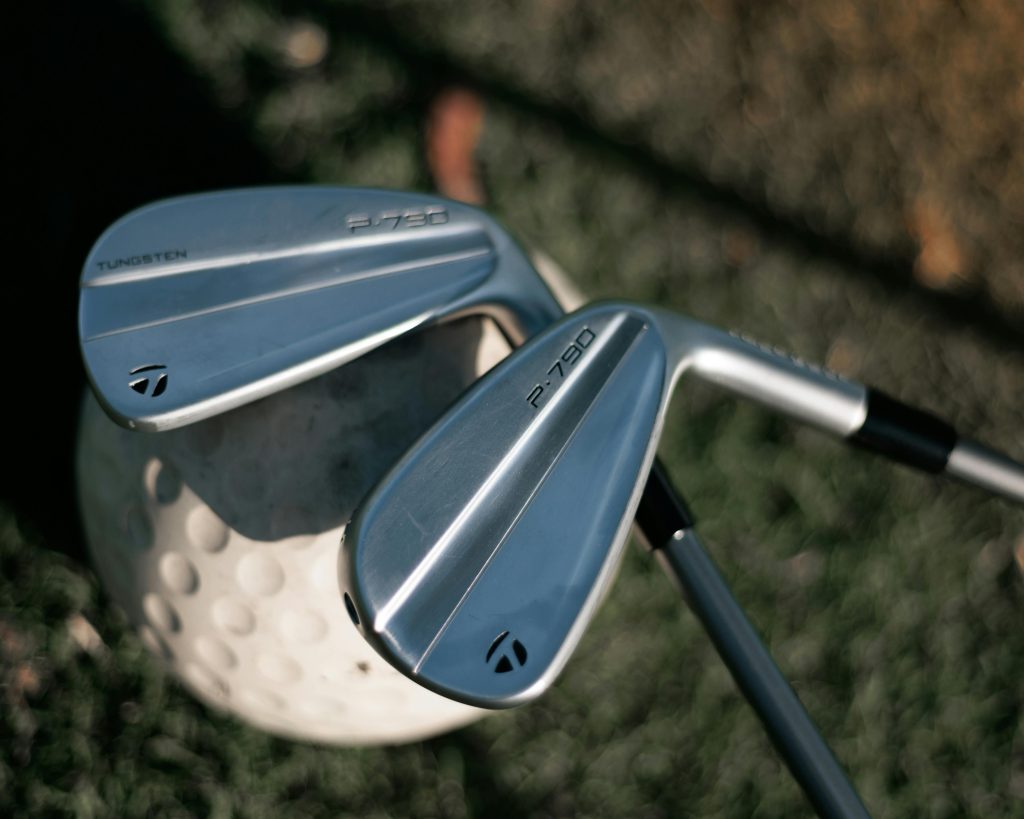
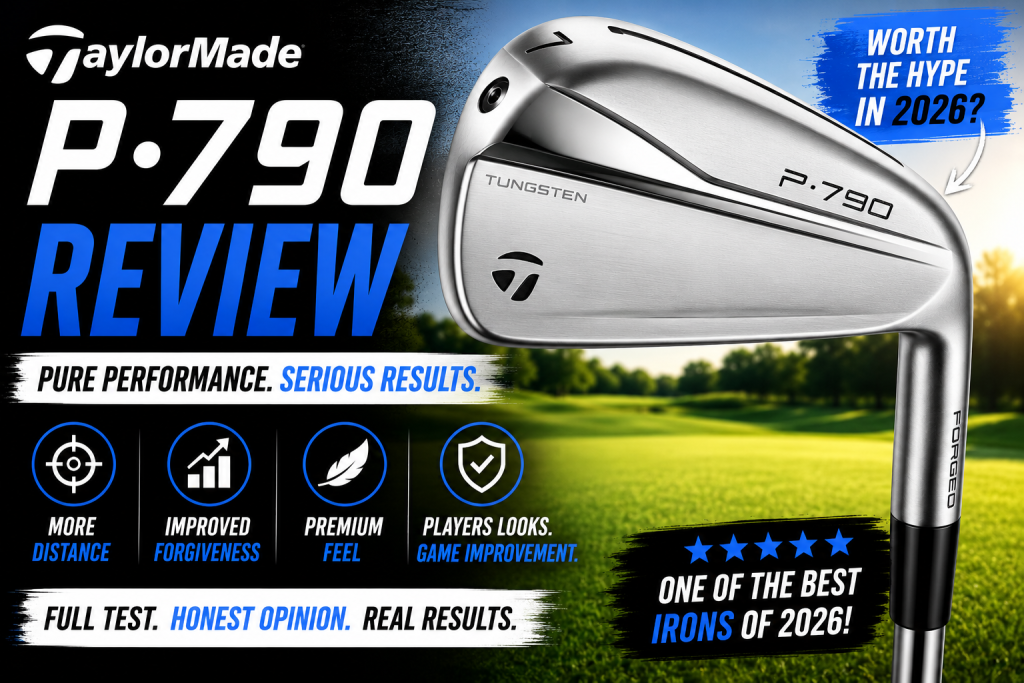
The P790 is the best players’ distance iron of 2026 and arguably the most broadly useful iron on the
market — it is fast enough to compete with game-improvement irons and accurate enough to
compete with players’ cavities, which almost nothing else manages. If you sit anywhere between a
20-handicap and scratch, it belongs on your shortlist.
The test data
Today’s Golfer tested 81 irons across every category in 2026. Against the 21 other players’ distance
irons, the P790 returned:
Metric
P790
Category average
Ball speed
126.8 mph
124.7 mph
Verdict
Carry distance
2nd fastest of 21
185.2 yds
181.3 yds
Launch angle
Among the longest
16.8°
16.7°
Descent angle
Very playable flight
47°
46.6°
Holds greens
Metric
P790
Category average
Left-right dispersion
Verdict
3.5 yds
6.6 yds
3rd tightest — ~50%
better
The dispersion number is the one to look at. Nearly half the category average means the P790 is not
buying its distance with wildness, which is the usual trade.
Why it is unusual
Against the game-improvement category averages — irons built specifically for distance and
forgiveness — the P790 delivered slightly more ball speed, effectively identical carry, a higher
launch, a steeper descent and more than twice as tight a dispersion.
Against the players’ cavity averages — irons built for control — it produced 5.6mph more ball speed,
12.4 yards more carry, a slightly steeper descent and roughly half the dispersion.
Beating one category is normal. Beating both, in opposite directions, is not. That is why this iron has
now topped Today’s Golfer’s test three years running, and why it also made Golf Digest’s 2026 Hot
List.
Wain’s summary: “Every year I wonder if we’ll see this iron knocked off its crown, and every year it
holds up… The change to sole shaping makes it easy to hit from any lie you can find.”
What actually changed in this generation
• A new face material (4340M) — 20% stronger than the previous generation, which lets
TaylorMade make it thinner. Thinner face, faster ball speed, and a sweet spot up to 24% larger.
• Up to 40g of tungsten repositioned inside the head.
• FLTD CG — the centre of gravity sits lowest in the long irons (easier to launch) and progressively
higher through the short irons (better spin and trajectory control). It is why the set produces a
consistent peak height rather than ballooning wedges and low, dead 4-irons.
• SpeedFoam Air behind the face for feel and feedback, plus a thinner topline and reshaped sole.
Specification
Availability
Dexterity
4-PW, AW
Right and left handed
Stock steel shafts
Stock graphite shafts
KBS Tour (R/S/X), KBS Tour Lite (R/S)
Mitsubishi MMT (75S / 65R / 55A)
Stock grip
Golf Pride Z-Grip Plus 2
Who should buy them
• Mid-handicappers — you get the ball speed without the usual accuracy penalty. The misses stay
playable.
• Low-handicappers — compact look, controlled flight, and enough descent angle to stop the ball.
• Golfers losing swing speed — this is the case nobody makes loudly enough. The P790 recovers
distance without forcing you into a bulky game-improvement head you don’t want to look down
at.
• Improving golfers with money — Today’s Golfer make the point well: buy a beginner-friendly
set and you may outgrow it in two years. The P790 is playable now and still right when you’re
breaking 90.
Who should buy something else
Two groups, honestly:
• Blade players who want maximum workability and feedback. A true muscleback gives you more
of both. The P790 is a hollow-body — it will never talk to your hands the way a blade does.
• Golfers who want maximum forgiveness with no effort. A larger game-improvement head has a
bigger profile and straightens mishits more readily. The P790 is forgiving for what it is; it is not a
Ping G-series.
And the obvious one: at four figures, this is not a first set of irons. If you are new to golf, a package
set will serve you better and cost a fifth as much.
What beats it, and where
Being specific matters more than a blanket recommendation. In the same Today’s Golfer test, the
Ping i530, Mizuno Pro M-15 and Callaway Apex Ai 200 all carried the ball slightly further than the
P790 — but none matched it for launch, spin, descent angle or dispersion. Some irons in the test
landed steeper, but gave up as much as 14 yards of carry to do it.
So: if raw carry is the only thing you care about, there are longer irons. If you want the whole
package, this is the one.
Bottom line
The P790 has no weak spot, which is rare and is exactly why it keeps winning tests. It is expensive, it
is not a beginner’s iron, and a blade purist will find it muted. Everyone else between those two
extremes should hit it before buying anything else.
Get fitted. At this price, buying off the shelf and hoping the stock KBS Tour suits you is the most
expensive mistake available.